


・
9 Best Marketo Alternatives in 2027: Why Users Switch

Marketo, now known as Adobe Marketo Engage, is a powerful marketing automation platform designed to help businesses manage complex campaigns, nurture leads, and measure marketing performance. However, its extensive capabilities may come with challenges, including a steep learning curve, a complex interface, and the cost of implementation and ongoing management.
If your team is considering moving away from Marketo, there are several alternatives worth exploring. Some offer dedicated marketing automation features, while others focus on customer engagement, email marketing, or broader business automation.
In this guide, we’ll look at nine Marketo alternatives, examine reviews from users on Reddit, G2, and Capterra, and explain how to choose a platform that fits your business needs.
Why Do Users Look for Marketo Alternatives?
To understand why businesses consider switching from Marketo, we examined user discussions on Reddit and reviews on G2 and Capterra.
What Reddit Discussions Reveal
We categorized Reddit posts related to Marketo by their primary complaint. The results show that product quality and functional issues were the most frequently discussed concerns.
Key findings from Reddit discussions:
- Product Quality and Functional Issues: 38.7%
- Pricing, Contracts, and ROI: 17.3%
- UI/UX and Usability: 14.7%
- Data and Reporting: 9.3%
- Other Dissatisfaction: 9.3%
- Competitor Comparisons and Switching: 4.0%
- Support and Vendor Response: 4.0%
- Implementation, Migration, and Learning: 2.7%
The largest category was product quality and functional issues. Users discussed problems with integrations, data handling, email functionality, and campaign operations.
Pricing and ROI were another significant concern. Some users questioned whether the platform's cost was justified, particularly when their teams were not using all its capabilities or needed additional resources to manage it.
Usability was also a recurring theme. Some discussions described Marketo as difficult to navigate and maintain, especially for users who were not dedicated marketing operations specialists.
What G2 and Capterra Reviews Reveal
We also analyzed reviews on G2 and Capterra.
The percentages below represent the share of total complaint mentions, rather than the percentage of reviews. A single review may mention multiple issues.
Key findings from G2 and Capterra reviews:
- Outdated UI/UX, Slow Loading, and Frequent Crashes: 21%
- Steep Learning Curve and Complex Terminology: 20%
- Customer Support and Delayed Responses: 17%
- Email, Landing Page, and Form Builder Limitations: 15%
- Reporting, Analytics, and Tracking Issues: 11%
- CRM Integration and Synchronization Problems: 9%
- High Licensing Costs and Poor Fit for Smaller Teams: 7%
These reviews highlight a combination of usability and operational concerns.
The interface and performance were the most frequently mentioned issues. Users described outdated screens, slow page loading, and browser-related crashes.
The learning curve was another major concern. Marketo uses concepts such as Smart Lists, Programs, and Tokens, which can take time for new users to understand. Some reviewers also described relying on dedicated administrators or external consultants to manage the platform.
Customer support and content creation tools were also recurring topics. Some reviewers reported long waits for support responses, while others described difficulties with email editors, landing pages, and forms.
What These Findings Mean for Businesses
The two sources point to a similar overall challenge: Marketo's extensive capabilities can require substantial resources to use and maintain.
The findings also do not mean that Marketo is unsuitable for every business. Its advanced marketing automation capabilities may be valuable for organizations with complex requirements and dedicated marketing operations teams.
For businesses that prioritize ease of use, lower operational overhead, or broader automation across departments, however, it may be worth considering a different approach.9 Best Marketo Alternatives in 2027
1. Yoom — All-in-One AI Automation for Every Team
Best for: Businesses that want to automate marketing-related processes using their existing apps, while also improving operations across other departments.
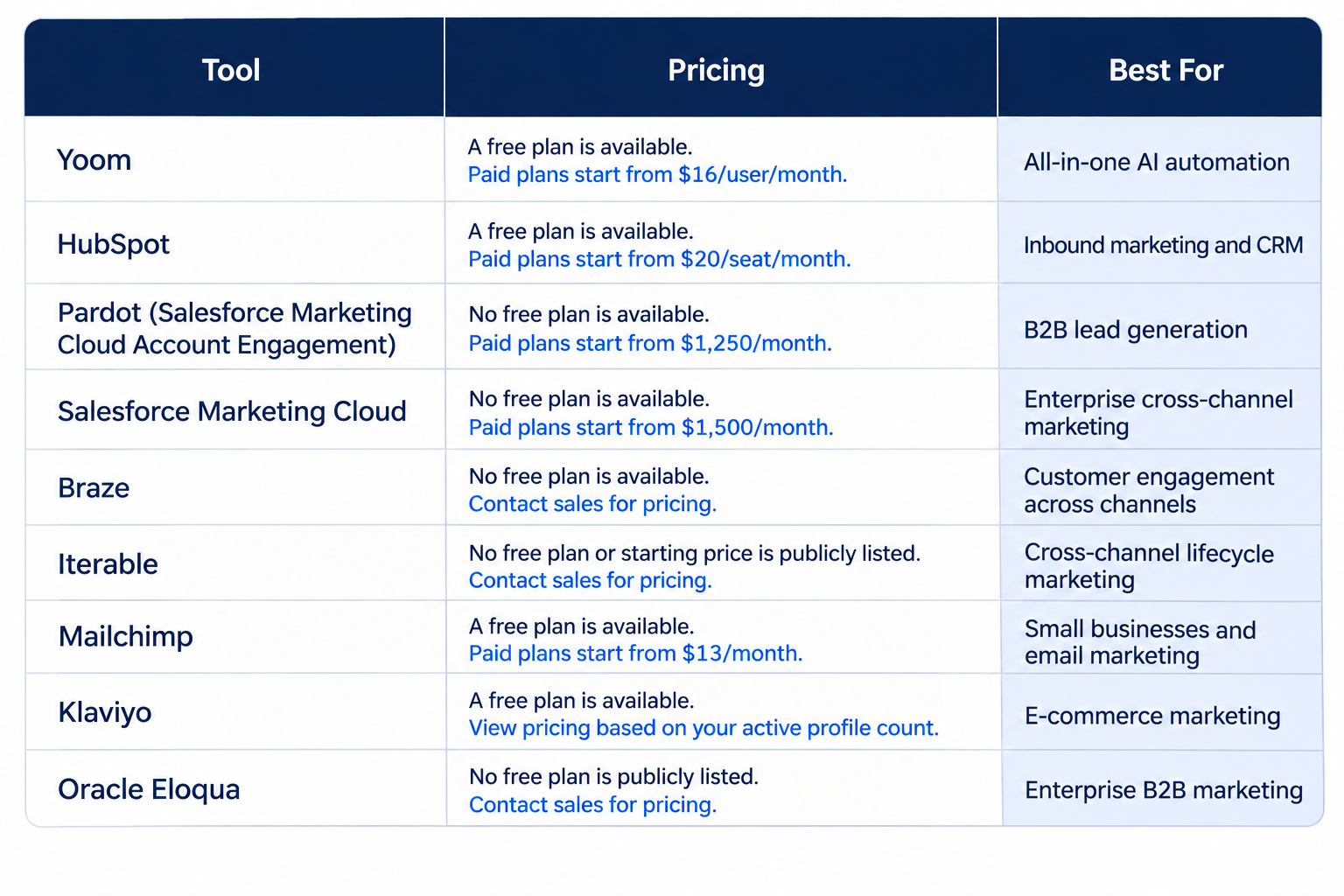
Visit Yoom | A free plan is available. Paid plans start from $16/user/month.
Unlike traditional marketing automation platforms, Yoom takes a broader approach to automation.
Rather than replacing every marketing tool with a single specialized platform, Yoom helps businesses connect the apps they already use and automate processes between them. This makes it possible to build an automation environment around existing business systems and specific operational needs.
Yoom is an all-in-one AI automation platform that combines AI, app integrations, workflow automation, databases, forms, and other capabilities.
Key Features
- AI Worker: Use natural-language instructions to build and execute AI-powered tasks.
- Workflow: Automate routine processes, approvals, and repetitive tasks based on predefined rules.
- App Integrations: Connect business applications and automate data transfers between them.
- Database: Store and manage operational information in a centralized database.
- Forms: Collect information through forms and connect submissions to automated processes.
- AI-OCR: Extract information from documents and use it in subsequent workflows.
- RPA: Automate browser-based and other repetitive operations.
Why Consider Yoom Instead of a Dedicated Marketing Automation Platform?
Yoom is not a one-to-one replacement for every specialized Marketo feature. Businesses that rely heavily on advanced lead scoring, complex campaign orchestration, or built-in marketing analytics should evaluate those requirements separately.
However, if your goal is to connect existing applications, reduce repetitive work, and build automation that fits your company's processes, Yoom offers a different approach.
Instead of purchasing and maintaining another specialized platform, you can use an all-in-one automation platform to improve processes across the organization.
2. HubSpot — All-in-One CRM and Marketing Automation
Best for: Businesses looking for an integrated CRM and marketing platform.
Visit HubSpot | A free plan is available. Paid plans start from $20/seat/month.
HubSpot is a popular alternative for businesses that want to manage marketing, sales, and customer relationships in one platform.
Its Marketing Hub provides tools for email marketing, landing pages, forms, lead management, campaign automation, and reporting. Because it is connected to HubSpot's CRM, teams can manage customer information and marketing activities within the same ecosystem.
Key Features
- Email marketing and automation
- Landing pages and forms
- Marketing workflows
- Lead scoring and segmentation
- CRM and contact management
- Campaign analytics and reporting
Why Consider HubSpot?
HubSpot is worth considering if your organization wants to bring marketing and sales operations closer together.
Its integrated CRM can help teams manage contact information and track interactions without relying on separate systems for every activity.
However, costs can increase as contact volumes, seats, and feature requirements grow. Businesses should also evaluate whether its workflow capabilities and customization options meet their specific needs.
3. Salesforce Marketing Cloud Account Engagement (formerly: Pardot) — B2B Marketing Automation
Best for: B2B companies that use Salesforce CRM and need lead nurturing and scoring.
Visit Salesforce Account Engagement | No free plan is available. Paid plans start from $1,250/month
Salesforce Marketing Cloud Account Engagement, formerly known as Pardot, is a B2B marketing automation platform designed to help businesses generate, qualify, and nurture leads. It offers features such as email marketing, lead scoring, and engagement tracking, with a strong focus on aligning marketing activities with Salesforce CRM and sales teams.
Key Features
- Lead scoring and grading
- Email marketing automation
- Engagement programs
- Landing pages and forms
- Prospect tracking
- Salesforce CRM integration
Why Consider Salesforce Marketing Cloud Account Engagement ?
For organizations already using Salesforce CRM, Account Engagement can provide a closer connection between marketing and sales activities.
Marketing teams can use prospect engagement data to support lead qualification and follow-up by sales teams.
However, companies should consider the Salesforce ecosystem and its associated costs when evaluating this option. It is also important to confirm that the available features match the organization's marketing requirements.
4. Salesforce Marketing Cloud Engagement (formerly ExactTarget) — Enterprise Customer Engagement
Best for: Large organizations managing complex, cross-channel customer journeys.
Visit Salesforce Marketing Cloud | No free plan is available.Paid plans start from $1,500/month
Salesforce Marketing Cloud is designed for businesses that need to manage customer engagement across multiple channels.
It offers capabilities for email marketing, mobile messaging, customer journeys, personalization, and campaign analytics.
Key Features
- Cross-channel campaign management
- Customer journey orchestration
- Email and mobile messaging
- Audience segmentation
- Personalization
- Marketing analytics
Why Consider Salesforce Marketing Cloud?
Salesforce Marketing Cloud may be suitable for enterprises with complex customer engagement strategies and multiple communication channels.
Its integration with the broader Salesforce ecosystem can also help organizations connect marketing activities with customer and sales data.
However, its extensive capabilities may require careful implementation and ongoing administration. Businesses should assess the complexity and total cost of ownership before choosing it.
5. Braze — Cross-Channel Customer Engagement
Best for: Businesses focused on personalized customer communication across digital channels.
Visit Braze | No free plan is available. Contact sales for pricing.
Braze is a customer engagement platform that helps businesses create personalized experiences across channels such as email, mobile push notifications, in-app messaging, and SMS.
It is particularly relevant for companies that want to manage ongoing customer engagement rather than focus only on traditional B2B lead nurturing.
Key Features
- Cross-channel messaging
- Customer journey orchestration
- Audience segmentation
- Real-time personalization
- Campaign testing and optimization
- Customer engagement analytics
Why Consider Braze?
Braze is worth considering if your business relies on frequent communication with customers across multiple digital channels.
Its approach is especially relevant for consumer-facing businesses, mobile applications, and companies that prioritize customer retention and engagement.
However, businesses with primarily B2B lead-generation needs should compare its capabilities with platforms specifically designed for lead management and sales alignment.
6. Iterable — Cross-Channel Marketing Automation
Best for: Marketing teams that want to coordinate personalized campaigns across multiple channels.
Visit Iterable |No free plan or starting. Contact sales for pricing
Iterable is a cross-channel marketing platform designed to help businesses create and manage personalized customer journeys.
It supports communication across channels and uses customer data to help marketers deliver relevant messages at different stages of the customer lifecycle.
Key Features
- Cross-channel campaign management
- Email and SMS marketing
- Customer segmentation
- Journey orchestration
- Personalization
- Campaign analytics
Why Consider Iterable?
Iterable may be a good fit for marketing teams that need to coordinate campaigns across multiple channels and respond to customer behavior.
It is particularly relevant for organizations that want to build more personalized customer journeys.
As with other enterprise-oriented engagement platforms, businesses should evaluate implementation requirements, integrations, and pricing based on their expected usage.
7. Mailchimp — Email Marketing and Campaign Automation
Best for: Small and medium-sized businesses that want accessible email marketing tools.
Visit Mailchimp | A free plan is available. Paid plans start from $13/month
Mailchimp is an email marketing platform that helps businesses create campaigns, manage audiences, and automate communications.
Compared with more complex marketing automation platforms, Mailchimp is often considered by teams that want to get started with email marketing without implementing a large enterprise system.
Key Features
- Email campaign creation
- Audience management
- Marketing automation
- Email templates
- Segmentation
- Campaign reporting
Why Consider Mailchimp?
Mailchimp can be a practical option for businesses whose primary requirements are email campaigns, audience management, and basic marketing automation.
Its relatively focused feature set may also make it easier for smaller teams to get started.
However, companies that depend on advanced B2B lead scoring, complex lifecycle management, or sophisticated CRM synchronization should carefully compare its capabilities with their requirements.
8. Klaviyo — Customer Segmentation and Marketing Automation
Best for: Businesses that want to personalize customer communications using behavioral data and automated messaging.
Visit Klaviyo | A free plan is available. Paid plans are based on active profile and usage limits
Klaviyo is a marketing automation platform known for its customer segmentation and behavior-based messaging capabilities.
It helps businesses organize customer data, create targeted audience segments, and automate personalized communications through email and SMS. While it has strong roots in e-commerce marketing, its segmentation and automation features can also support customer engagement programs in other industries.
Key Features
- Advanced customer segmentation
- Automated email and SMS campaigns
- Behavior-based triggers and customer journeys
- Personalized messaging using customer data
- Campaign and engagement analytics
- Third-party app integrations
Why Consider Klaviyo?
Klaviyo is worth considering for businesses that need to send relevant communications based on customer behavior, preferences, and engagement history.
For example, teams can automate follow-up emails based on customer activity, send reminders to specific audience segments, and personalize communications throughout the customer lifecycle.
However, businesses that rely on complex CRM integrations, extensive data synchronization, or highly specialized B2B sales processes may need additional tools to support their requirements.
9. Oracle Eloqua — Enterprise B2B Marketing Automation
Best for: Large B2B organizations with complex marketing operations.
Visit Oracle Eloqua | No free plan is publicly listed. Paid plans start at $2,000/month for up to 10,000 contacts (Basic).
Oracle Eloqua is an enterprise marketing automation platform designed to help businesses manage complex B2B campaigns and customer journeys.
It provides tools for lead management, campaign execution, segmentation, and marketing performance measurement.
Key Features
- Campaign orchestration
- Lead scoring and nurturing
- Audience segmentation
- Email marketing
- CRM integration
- Marketing analytics
Why Consider Oracle Eloqua?
Eloqua may be suitable for organizations with sophisticated B2B marketing processes and established marketing operations teams.
Its capabilities can support complex campaigns and large-scale lead management.
However, businesses should consider the implementation effort, technical requirements, and total cost of ownership before choosing another enterprise-level platform.
How to Choose the Right Marketo Alternative
The best Marketo alternative depends on what your organization needs to improve.
Before switching platforms, consider the following questions.
1. Do You Need a Dedicated Marketing Automation Platform?
If your business relies on advanced lead scoring, multi-step nurture campaigns, and complex marketing attribution, a dedicated marketing automation platform may be the right choice.
However, not every company needs all of these capabilities.
If your main challenges involve repetitive tasks, disconnected applications, and manual data transfers, a broader automation platform may be sufficient for many of your processes.
2. Can You Continue Using Your Existing Apps?
Switching to a new platform does not always solve the underlying problem.
Your business may already use separate tools for CRM, forms, email marketing, analytics, and customer communication.
Instead of replacing all of them, consider whether connecting your existing applications could create a more efficient process.
This approach may reduce migration work and help teams continue using tools they already understand.
3. How Much Administration Will the Platform Require?
A platform's license fee is only one part of its total cost.
You should also consider:
- Implementation and migration expenses
- Training and onboarding
- Dedicated administrator requirements
- External consultant fees
- Ongoing maintenance
- Additional costs as usage grows
A platform with more features is not necessarily the most cost-effective option if your team does not have the resources to use and maintain them.
4. Do You Want to Automate More Than Marketing?
Marketing processes often depend on other departments.
For example, lead information may need to move between marketing, sales, and customer support. Contract information, customer data, and internal approval processes may also be connected to marketing activities.
If your goal is to improve operations across the organization, an all-in-one automation platform may provide more flexibility than a tool designed exclusively for marketing.
Choose an Automation Approach That Fits Your Business
Marketo offers extensive marketing automation capabilities, but its complexity, usability concerns, and operational requirements may not suit every organization.
The user feedback we analyzed highlights recurring concerns around product quality, interface usability, learning requirements, and customer support. These issues are worth considering when evaluating whether your current platform still fits your team's needs.
If your business needs advanced B2B marketing capabilities, platforms such as HubSpot, Salesforce Marketing Cloud Account Engagement, and Oracle Eloqua are worth comparing.
For cross-channel customer engagement, Braze and Iterable may be relevant options. Mailchimp and Klaviyo are also worth considering for businesses with more focused email or e-commerce marketing needs.
However, replacing Marketo with another dedicated marketing platform is not the only option.
If your main goal is to reduce manual work, connect existing applications, and automate processes across departments, Yoom offers a different approach.
With AI, app integrations, workflow automation, databases, and forms in one platform, Yoom helps businesses build automation around their existing tools and processes.
Rather than introducing another specialized system for marketing alone, you can use automation to improve how your entire organization works.